Why Kidepo Valley National Park Matters
Kidepo Valley National Park: The Complete Guide to Uganda's Last Great Wilderness
Tucked into Uganda's far northeastern corner, where the borders of South Sudan and Kenya meet, Kidepo Valley National Park is the country's most remote and least-visited safari destination, and by many accounts one of the most beautiful in all of Africa. CNN Travel has ranked it among the continent's finest national parks, and anyone who makes the long journey north quickly understands why.
This is the Africa of the imagination: endless golden savannah hemmed in by distant mountains, herds gathering at shrinking waterholes, lions stretched out on sun-warmed rocks, and barely another vehicle in sight. If you're craving a true wilderness safari away from the crowds, Kidepo is hard to beat. Here's everything you need to know to plan your trip.
Why Visit Kidepo Valley National Park?
Kidepo is Uganda's most scenic and untouched safari park, often compared to Kenya's Maasai Mara or Tanzania's Serengeti. It offers large, easy-to-spot populations of lions, buffalo, and elephants, and it is the only place in Uganda where you can see wild ostriches and cheetahs. Birders are spoiled too, with more than 470 recorded species. Add authentic cultural encounters with the Karamojong and the Ik people, and the fact that it sees far fewer visitors than Murchison Falls or Queen Elizabeth, and you have a park where you'll often have the views entirely to yourself.
A Landscape of Untamed Beauty
First gazetted as a national park in 1962, Kidepo covers around 1,442 square kilometres of semi-arid valley in the Karamoja region. From Apoka, the park's central tourism hub, the savannah rolls out in every direction, framed by rugged ranges including Mount Morungole.
The park is shaped by two seasonal rivers, the Kidepo and the Narus. During the dry months they shrink to scattered pools, and those pools become lifelines, drawing wildlife into tight, photogenic concentrations. The Narus Valley is the park's prime game-viewing area for exactly this reason, with reliable water that attracts lions lazing on rocky outcrops, some of the largest buffalo herds anywhere on Earth, and elephants that have recovered to several hundred from a low of around 200 in the 1990s. Zebras, hartebeests, and a wide cast of antelope round out the scene.
Kidepo is also one of the best places in Uganda to see Rothschild's giraffe, whose local population has rebounded strongly from a 1990s low thanks to dedicated breeding and translocation efforts.
Birdwatching: A Paradise for Ornithologists
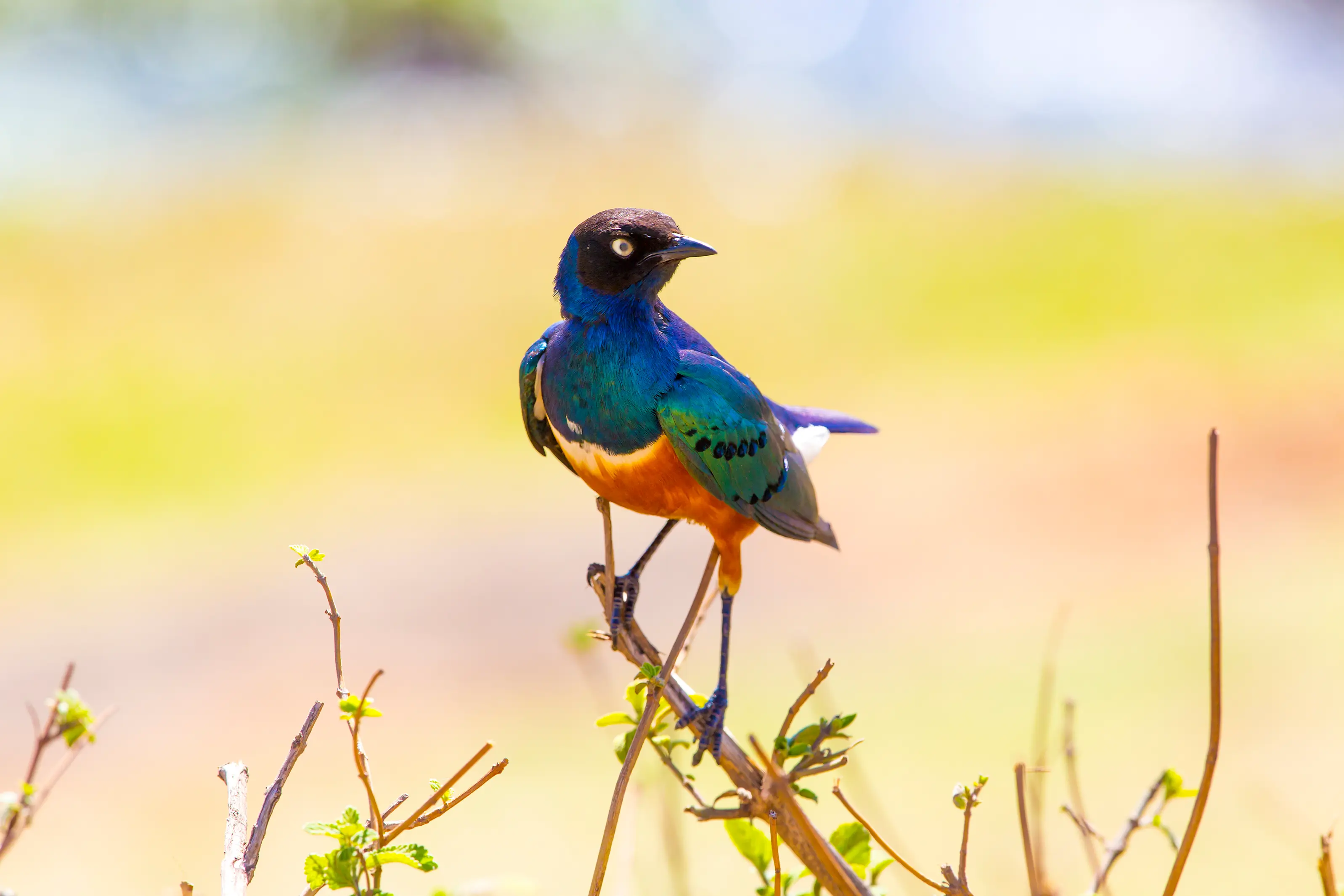
With a checklist of more than 470 species, Kidepo is a dream for birders, and home to several species you won't find in any other Ugandan park. Ostriches roam wild here, the only place in Uganda where they do, and secretary birds stride across the open plains. Bright flashes of colour come from northern carmine and little green bee-eaters, while keen birders will be hunting for the prized Abyssinian scimitarbill, along with Kori bustards, Karamoja apalis, and Clapperton's francolin.
A Unique Cultural Experience
Kidepo isn't only about wildlife. The surrounding region is home to two remarkable communities. The Karamojong are semi-nomadic pastoralists whose cattle-centred culture and warrior heritage draw natural comparisons to Kenya's Maasai; a visit to a traditional homestead, known as a manyatta, usually includes music, dance, and storytelling. The Ik people are one of Uganda's smallest ethnic groups, living high in the Morungole mountains, and reaching them involves a guided hike that makes the visit as much an adventure as a cultural exchange. Cultural fees help fund local projects such as borehole construction, meaningful support in this dry, water-scarce region.
Things to Do in Kidepo
Game drives are the heart of any visit. The Narus Valley delivers the big herds and predators by day, while the Kidepo Valley offers dramatic landscapes and the dry riverbed; night drives with a UWA ranger give you a strong chance at nocturnal hunters. Birdwatching is best at first light and is exceptional in the wet season when migratory species arrive. Beyond the vehicle, you can take guided nature walks around Apoka or climb Mount Morungole, visit the scenic Kanangorok Hot Springs near the South Sudan border, and spend time with the Karamojong and Ik communities.
Best Time to Visit
Kidepo sits in a semi-arid region and is open year-round, but the experience changes with the seasons.
The dry season, from September to March, is best for wildlife. Animals concentrate around the remaining waterholes in the Narus Valley, the grass is short, and sightings are easier. December to February is the hottest and dustiest stretch, so haze can occasionally affect long-distance views.
The wet season, from April to August, is best for birding and scenery. The plains turn lush and green and migratory birds arrive, though some tracks become muddy and slippery, so a sturdy 4x4 is essential. For the best all-round balance of good weather and excellent game viewing, many travellers favour September to early November.
How to Get There
Kidepo's remoteness is part of its magic, but it does require planning.
By road, the park lies roughly 570 km north of Kampala, a 9 to 12 hour drive depending on route and conditions. The most common route runs via Gulu and Kitgum, while longer routes through Karamoja via Moroto take more time but reward you with cultural scenery. The main roads are tarmac for much of the way and rougher near the park, so a 4x4 is strongly recommended. Many travellers break the journey with an overnight stop, and Ziwa Rhino Sanctuary, Uganda's only place to track wild rhino, is a popular choice.
By air is the quickest option by far. Scheduled and charter flights connect Entebbe, and Kajjansi airfield, with Apoka Airstrip inside the park, cutting travel time to roughly two hours. Aerolink Uganda operates scheduled services on selected days of the week, and lodges typically arrange airstrip transfers. Flights cost considerably more than driving but are well worth it on a short trip, so confirm current schedules and fares when you book.
Where to Stay
Accommodation ranges from premium lodges to simple bandas, most within an hour of the airstrip. For luxury, Apoka Safari Lodge is the standout property inside the park, with prices to match its setting. Mid-range travellers are well served by Kidepo Savannah Lodge, Nga Moru Wilderness Camp, and Adere Safari Lodge, which are comfortable and well-located, typically from around USD 150 per person per night. Budget-conscious visitors can opt for the Apoka UWA Bandas or the public campsites managed by the Uganda Wildlife Authority, which are simple, affordable, and a great way to feel close to the wilderness.
Park Entrance Fees (Guide Only)
Fees are collected by the Uganda Wildlife Authority (UWA), charged per person and valid for 24 hours. As a rough guide, daily entrance for foreign non-residents is in the region of USD 40 for adults and USD 20 for children. Foreign residents pay around USD 30 for adults and USD 10 for children, while East African citizens pay roughly UGX 20,000.
Game drives, vehicle entry, ranger guides, and cultural visits carry separate charges. UWA tariffs are reviewed periodically, so always confirm the current rates with your tour operator or UWA before you travel. Note that most visitors to Uganda also need a tourist visa, commonly USD 100, or an East Africa Tourist Visa if combining countries.
Final Word
Kidepo Valley National Park asks more of its visitors than Uganda's other parks. It's a long way from anywhere, and that's precisely the point. Those who make the journey are rewarded with vast, uncrowded landscapes, some of the best game viewing in East Africa, and a sense of genuine wilderness that's increasingly rare on the continent.
If you're looking for an authentic, off-the-beaten-path African safari, Kidepo is the ultimate destination. Plan ahead, give yourself a few days to soak it in, and prepare to fall for one of Africa's last true wildernesses.
Frequently Asked Questions
Where is Kidepo Valley National Park? It lies in the Karamoja region of far northeastern Uganda, in Kaabong district, bordering South Sudan and Kenya, roughly 570 km from Kampala.
What animals can I see in Kidepo? You can expect lions, elephants, buffalo, giraffes, zebras, and leopards, along with rare species like cheetahs and ostriches, plus a wide range of antelope and over 470 bird species.
When is the best time to visit Kidepo? The dry season from September to March is best for wildlife viewing, while the wet season from April to August is best for birding and lush scenery.
How do I get to Kidepo Valley National Park? You can take a 9 to 12 hour drive from Kampala in a 4x4, or fly roughly two hours from Entebbe to Apoka Airstrip.
How many days do I need? Plan for at least three days to make the long journey worthwhile and to fully explore the Narus and Kidepo valleys.